TL;DR
- You can pay Indian contractors from a stablecoin balance, and the payment lands in rupees in their bank account the same day. The route you pick decides whether it creates a tax problem for them or not.
- Sending USDC or USDT straight to your contractor's wallet is the fastest option and the most expensive one for them. They lose their zero-rated export status under GST and get no bank certificate for their refund claim.
- The thirty percent figure you have probably read about is mostly wrong. Section 115BBH taxes the gain on a digital asset sale, not your invoice value.
- A regulated payout platform converts your stablecoins outside India and credits your contractor in rupees, so they never touch a digital asset and their documentation stays intact.
- zPayments is a regulated payout platform which can be used for sending payouts to your Indian contractors in the most efficient and reliable manner. You complete KYB once, add your contractor as a beneficiary, fund your account in USDC or USDT, and pay out in rupees. Compliance is built into the platform, so it does not land on your finance team.
- Before your first payout, confirm which bank issues your contractor's certificate, what purpose code gets applied, and whether your provider holds the right authorisation in India.
You pay your developer in Bengaluru in USDC. It lands in eight minutes, the rate looks better than your bank's, and everyone is happy.
Then in October they email you asking for a document you have never heard of, because their chartered accountant has told them the payment cost them their export tax status and the refund they were counting on.
This happens constantly, and it is avoidable. Paying Indian contractors from a stablecoin balance works well when the money crosses into India as rupees through a licensed partner. It goes wrong when tokens land in your contractor's wallet and they have to sell them on a domestic exchange.
Here is how the routes differ, what your contractor actually pays in tax, which documents they need from the payment, and what to check before you send anything.
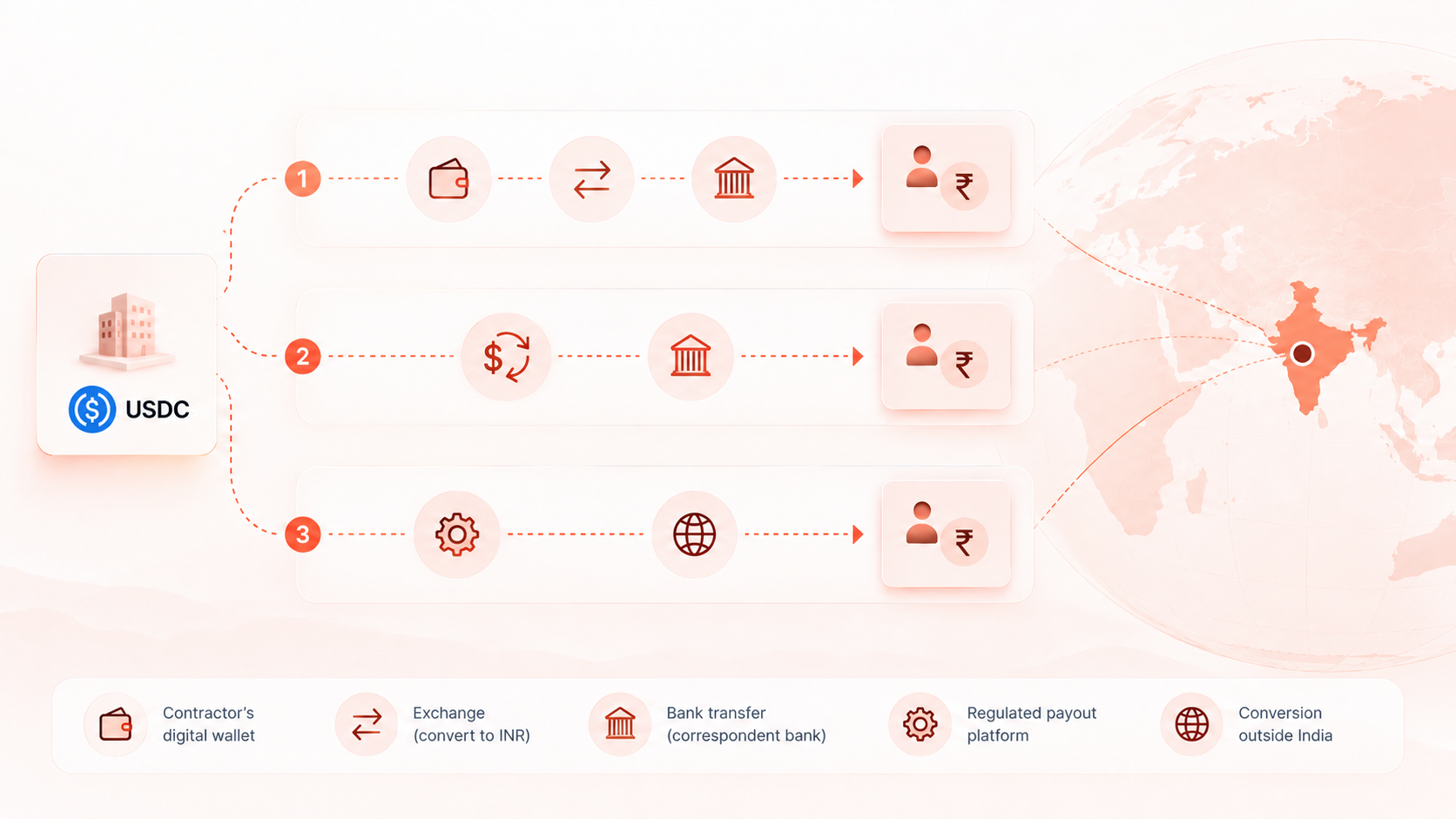
Three ways to pay Indian contractors in stablecoins
Pick the route before the first invoice. Switching in-between leaves a gap in your contractor's export records that takes weeks of emails to sort out.
|
|
|
|
| Route |
How it works |
What your contractor gets |
Bank certificate |
| Straight to their wallet |
You send USDC or USDT to their wallet. They sell it on an Indian exchange and withdraw rupees |
Rupees, after selling a digital asset |
No |
| Convert, then wire |
You convert to dollars, then send a correspondent banking wire |
Rupees, minus spread and intermediary fees |
Yes |
| Regulated payout platform |
You fund in stablecoins. Conversion happens outside India. Your contractor is credited in rupees over domestic rails |
Rupees |
Depends on the provider |
The first route is the one most guides recommend, because it is the easiest to describe. It is also the only one that leaves your contractor without a bank certificate, and that costs them more than any FX spread you could negotiate.
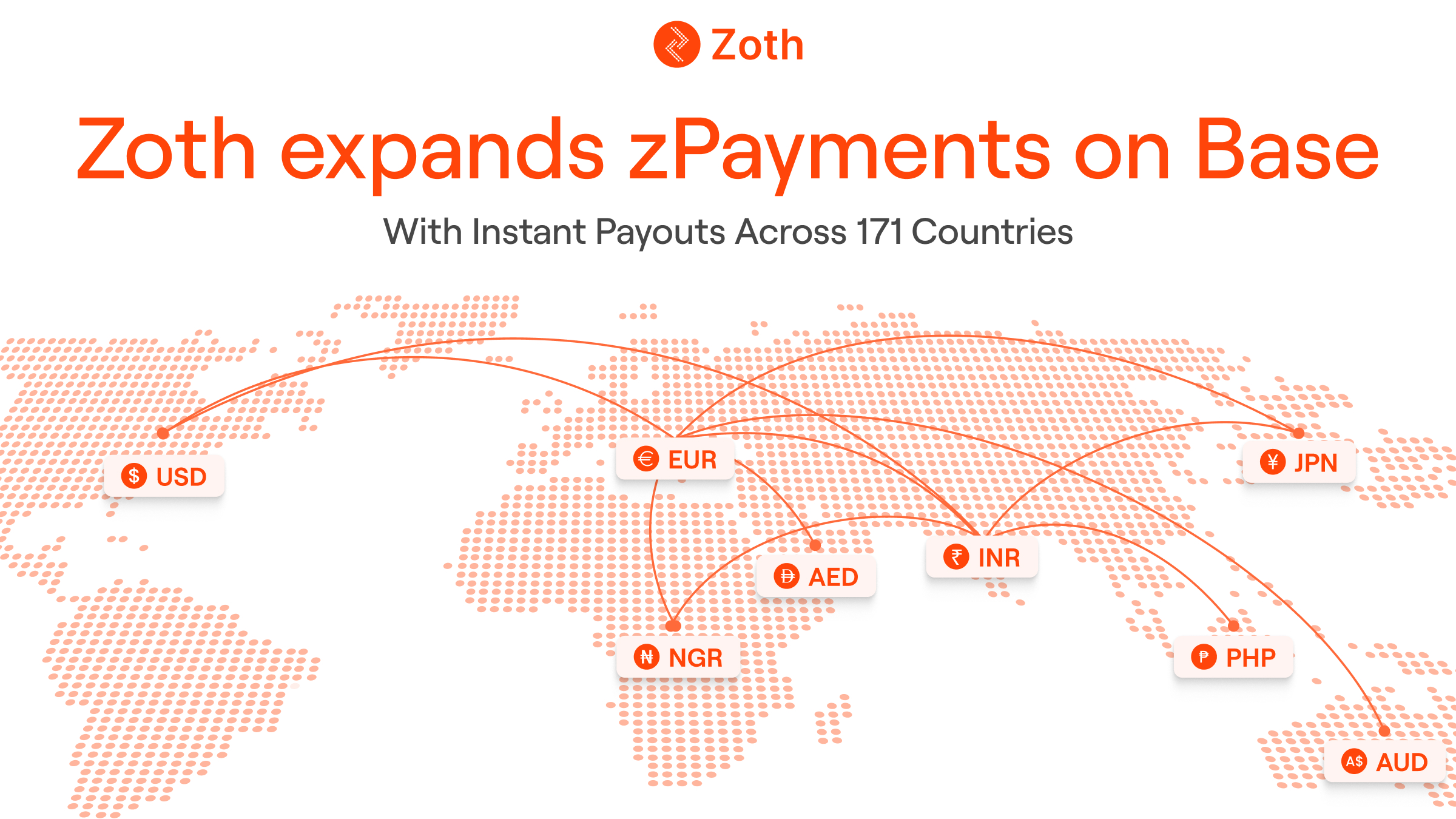
zPayments is a regulated payout platform built for the third route. You complete KYB once, add your contractor as a beneficiary, fund your account in USDC or USDT, and send the payment in rupees. Compliance runs inside the platform, so screening, Travel Rule checks and monitoring never reach your finance team. India is one of the main corridors.
How to pay an Indian contractor in stablecoins
The whole payment runs from one place and takes five steps.
Step 1: Verify your business
You verify your company with the payout platform once, using your incorporation documents, ownership structure and director list. Every payout after that runs against the verified entity, so you are not repeating this each month. On zPayments you do this at zpayments.zoth.io.
Step 2: Add your contractor as a beneficiary
You need their full legal name exactly as it appears on their bank account, their account number, IFSC code and PAN. Add one contractor or upload a batch of five hundred. Details are saved and reused, so your second payout to the same person takes seconds.
Step 3: Fund your account
Add USDC or USDT to your payout balance. Receipt is confirmed on chain in around five minutes.
Step 4: Confirm the rate and pay
You see the rate before you send, and it does not move between confirmation and settlement. Your contractor is credited in rupees to their bank account, and you can watch the status at transaction level until it lands.
Step 5: Send your contractor the payment reference
They need it to pull their bank certificate and match the payment against their own filings. It takes thirty seconds and saves both of you a week of emails at quarter end.
Notice what your contractor never does here. No wallet, no exchange account, no sale. Rupees arrive in their bank account and that is the end of it for them.
What Indian contractors pay in tax on stablecoin payments
The tax lands on your contractor, not on you, and what they pay depends on one thing: whether a digital asset ever reaches their hands.
If they are credited in rupees
The money is ordinary business income and they pay their normal rate on it. No digital asset entered their hands, so none of the Virtual Digital Asset rules apply. As long as the payment came through a channel their bank can certify, their export status under GST holds.
If they receive tokens in their wallet
Three things happen, and the one you have read most about is the least accurate.
The thirty percent charge is misreported. Section 115BBH taxes income from the transfer of a Virtual Digital Asset at thirty percent plus cess. That is a tax on gain, not on your invoice. If your contractor receives a token and sells it the same week, the gain is usually close to nothing, and the fee itself stays ordinary business income. Section 194S adds one percent TDS on the sale above the threshold.
They lose zero-rated export status. This is the expensive one. Under Section 2(6) of the IGST Act, a service only counts as an export when all five of these hold at once:
|
|
|
| # |
Condition |
What it means for you |
| 1 |
Supplier is in India |
Your contractor |
| 2 |
Recipient is outside India |
Your company |
| 3 |
Place of supply is outside India |
Set by Section 13, usually your location |
| 4 |
Payment received in convertible foreign exchange, or rupees where the RBI allows it |
The one your payment method controls |
| 5 |
Supplier and recipient are not the same legal person |
A subsidiary qualifies. A branch does not |
Tokens in a wallet are neither foreign exchange nor an approved rupee route, so condition four fails. Your contractor's service stops being an export, which means they may owe integrated tax they never charged you and lose the input tax credit refund they had budgeted for. The CBIC has confirmed that rupees received through Special Rupee Vostro Accounts do satisfy condition four, which shows how narrowly the approved rupee routes are drawn.
They get no bank certificate. Covered in the next section.
So the headline number is mostly noise. The export status is where the money actually goes.
What documents you need before paying in stablecoins
Your contractor's whole export position runs on a paper trail, and it starts with how your payment arrives.
The bank certificate. A Foreign Inward Remittance Certificate, or its electronic version the e-FIRA, comes from an Authorised Dealer Category-I bank and proves the money arrived through the banking channel. It is what evidences condition four above and what supports your contractor's GST refund. No payment platform issues one. If a provider tells you they do, they are describing something they cannot deliver. What a good platform does is route the payment so a bank can certify it and make the document available to your contractor.
That gives you a simple test for any payment method. Never mind what technology it runs on. Ask whether a bank certificate comes out at the end. Payments through the established international platforms qualify for exactly this reason.
The purpose code. Your contractor's bank applies this when the money lands, and it classifies the payment for FEMA reporting. The wrong code creates a mismatch that surfaces months later during a refund claim.
The invoice. It needs your company name and overseas address, the place of supply stated as outside India, and if your contractor exports under a Letter of Undertaking, a line saying export of services without payment of integrated tax. Bad invoice wording stalls more refund claims than anything else.
The Letter of Undertaking. Filed as Form GST RFD-11, it lets a registered exporter invoice without paying integrated tax upfront. It is your contractor's filing, not yours, but it changes the invoice they send you and it expires every financial year.
The realisation record. Export proceeds have to be realised within the window the RBI allows, now fifteen months from the date of export following the November 2025 amendment. Miss it and under Rule 96A of the CGST Rules your contractor pays the integrated tax they never charged, with interest, and claims it back once you pay. Their LUT can be suspended while that runs.
Send tokens to a wallet and the first three simply do not exist. There is no bank credit to certify, no purpose code to apply, and nothing for the realisation record to point at.
We hold zPayments to the same test. [INDIA_FIRC_MECHANISM_CONFIRMED]
When your contractor is legally an employee
No payment method fixes a misclassified worker, so settle this before you look at routes.
Indian law goes by substance, not by what the contract says. Fixed hours, your equipment, your management line and full integration into your team all point to employment, and that brings social security, gratuity and back pay exposure onto you.
There is a second exposure that catches agencies. India's double taxation treaties can give your company a permanent establishment in India if someone habitually acts on your behalf there, or if you furnish services in India past a threshold number of days. The tests and the day counts change from treaty to treaty.
Two things keep you clear. Write a genuine contract for services, with deliverables, the contractor's own tools and their own control over how the work gets done. And never give an Indian contractor authority to sign contracts in your name.
One freelance designer is not a permanent establishment. Eight people working full time under your direction is worth a conversation with an adviser before it becomes a conversation with an assessing officer.
What to check before your first payout
Every item here costs a five minute question now and a quarter of cleanup later.
Which bank issues the certificate. Ask your provider to name the Authorised Dealer bank. If the answer is that the platform issues it, keep looking.
What authorisation they hold in India. Non-bank providers handling cross-border payments for imports and exports fall under the RBI's Payment Aggregator Cross Border framework, brought in by circular on 31 October 2023. They need authorisation as a payment system operator, with FIU-IND registration first. Authorised Dealer Category-I banks do not need separate authorisation.
The transaction cap. The PA-CB framework caps a single transaction at twenty-five lakh rupees. Irrelevant for monthly contractor fees, material for a large project invoice.
Whether the payment matches the invoice exactly. Netted fees, rounding and part payments break the link between the money and the invoice it is meant to close, and your contractor has to explain the difference to the tax department.
Which purpose code gets applied. Ask now rather than after the first refund claim comes back.
Should you pay Indian contractors in stablecoins?
This works well if you:
- Already hold a stablecoin treasury and would rather not convert to fiat before paying
- Pay the same Indian contractors every month and want the run to take minutes
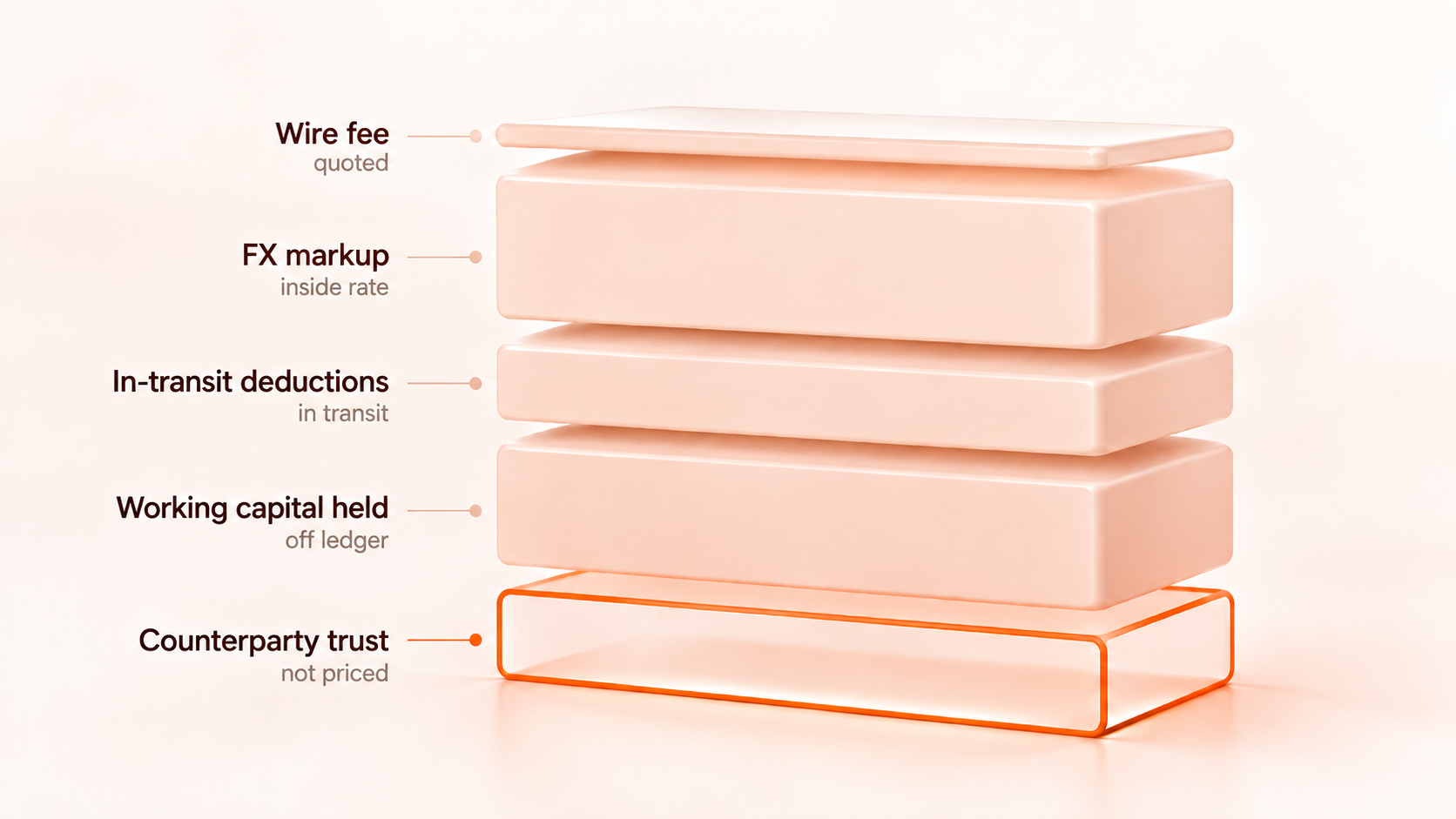
- Have been losing three to five percent to spread and intermediary fees on wires
- Need settlement the same day rather than in three to five business days
- Want screening and Travel Rule checks handled by the platform instead of your finance team
Think again if you:
- Are paying someone who is an employee in substance, where you need an employer of record instead
- Cannot get a straight answer from your provider about which bank certifies the receipt
- Are moving your own money to your own Indian entity, which is a different transaction entirely
Most businesses paying into India land on the third route because it costs less than a wire and creates no work for the contractor. The one thing worth spending time on is the documentation question, since that is where the money quietly goes.
Running your first payout on zPayments
zPayments pays contractors, vendors and suppliers in local currency from a stablecoin balance including USDC and USDT.
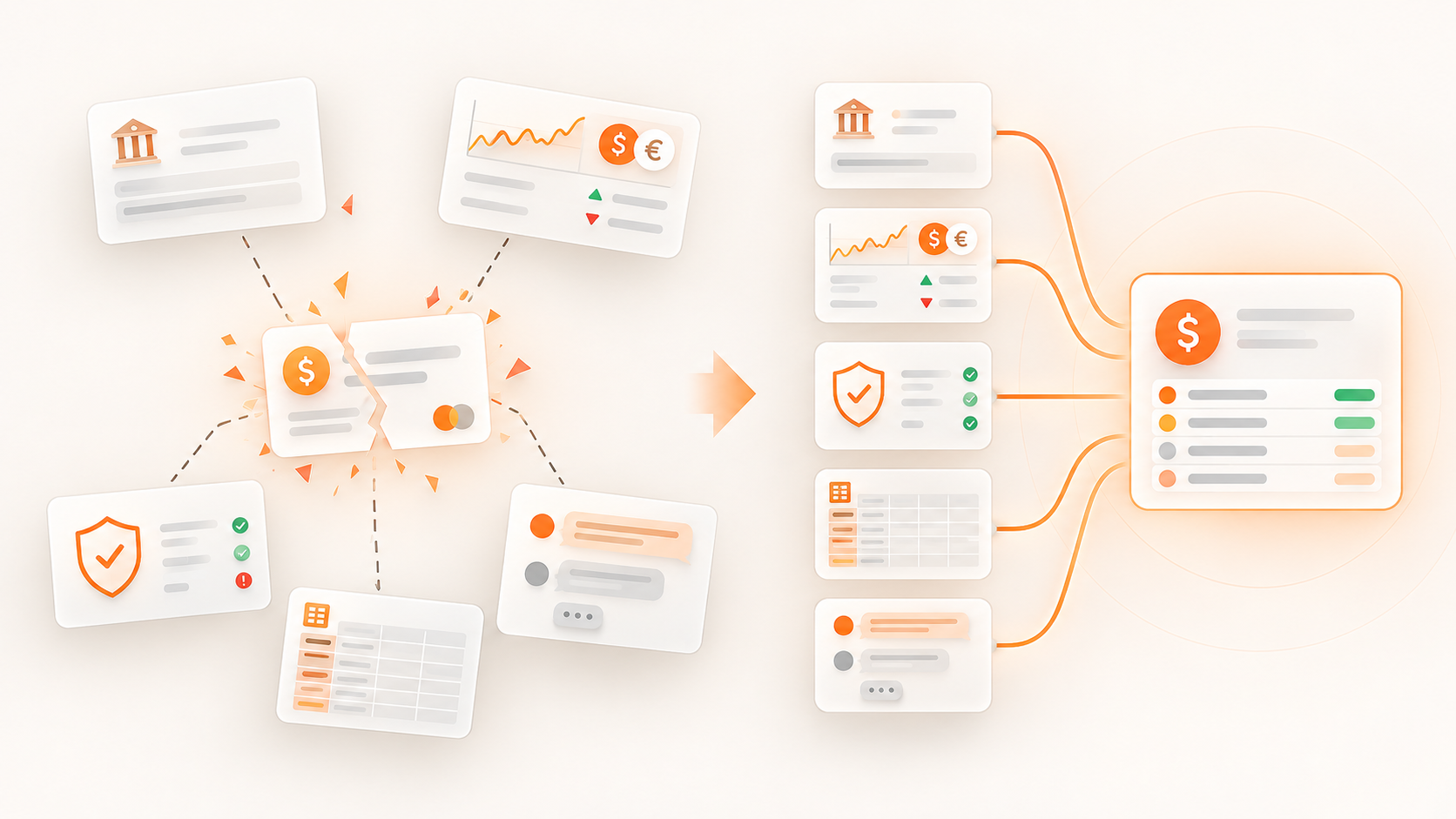
Users can use it through a unified platform that handles a single contractor invoice and a five hundred line payout run the same way, so nothing changes as your volume grows. You fund once, upload the run, and reconcile everything from a single ledger.
What happens when you send a payment. The rate locks when you agree it, before anything moves. You fund the licensed partner account in stablecoins or fiat and receipt confirms on chain in around five minutes. The balance converts to rupees at the locked rate, and your contractor is credited to their bank account while you watch each stage.
What you get back. Every payout returns the same export whichever corridor it went through, with verification evidence, screening result, rate applied, amount and payout confirmation. One format across every market is what saves your team at month end when they are matching payouts into four countries. Selected business partners also get one-click reconciliation, and eligibility is confirmed once your KYB is complete.
What you stop doing. Sanctions and adverse media screening, Travel Rule handling where it applies, and ongoing monitoring all sit inside the platform. Payout success rate is 99.1 percent, as at [SUCCESS_RATE_DATE]. Zoth is registered as a Money Services Business with FINTRAC, and payouts settle through licensed partners regulated in each corridor.
Book a walkthrough and we will run a live settlement while you watch the rate lock, the money move and the record being generated. Bring the checklist from above and we will answer it on the call.
Get corridor rate